Sunday, 16 september 2018
Oslo
Did I mention our interest in history museums? And if you’re in Scandinavia, is there any specific historic period or people that spring to mind? Right: the Vikings. Last week we went to the Viking Ship Museum in Rosskilde, near Copenhagen, and today we saw the Viking Ship Museum here in Oslo. We liked them both very much, and each has its own uniquities.
The ships on display are all from the Vikings’ heyday, about 750-1050 CE. All were discovered within the last 150 years, and all were painstakingly restored (of course only partially) relatively recently. All were in effect buried intentionally, but the similarity stops there. The ships now in Rosskilde were loaded up with rocks and sunk in a narrow inlet, as a barrier to prevent invaders’ ships from approaching the town. They sank into mud, which helped to preserve them. The ships now in Oslo were dragged onto land and buried in huge mounds, as tombs for important people; the wet clay also aided their preservation. And the Oslo ships were loaded with both treasures and objects of everyday life, presumably to help their (deceased) occupants thrive in the afterlife.
Here’s one of the ships in Rosskilde, with a little model of the complete thing in front of it: 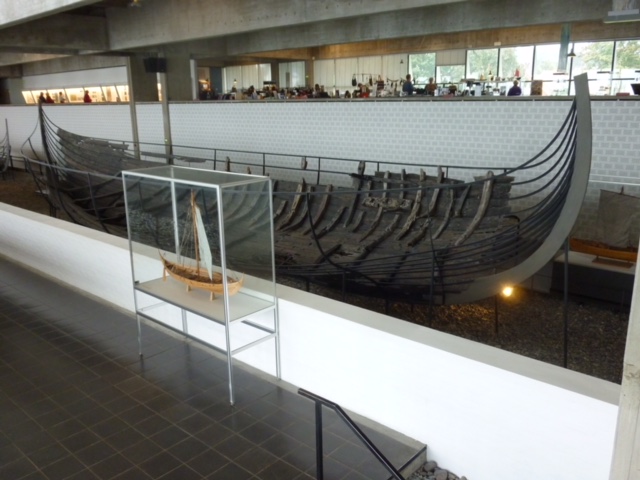
and here’s another view of the same ship: 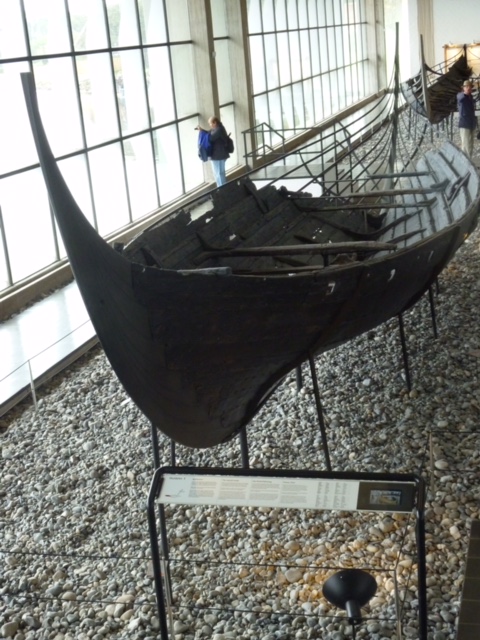
with a second ship behind it. The displays gave a lot of information about the recovery of the ships, which was a challenge. First, the harbor/shipping people were not happy with the archeologists blocking the inlet, and gave them only a few months to do the recovery work. Second, they had to build a cofferdam (see also construction of the Golden Gate Bridge) to create a dry area in the sea bed from which they dug up the remains, photographing and cataloging in detail as they went.
Today, one can see not only the reconstructed remains but also a replica ship, which has been sailed from Denmark to Ireland (among other voyages). It’s the yellow and orange boat here: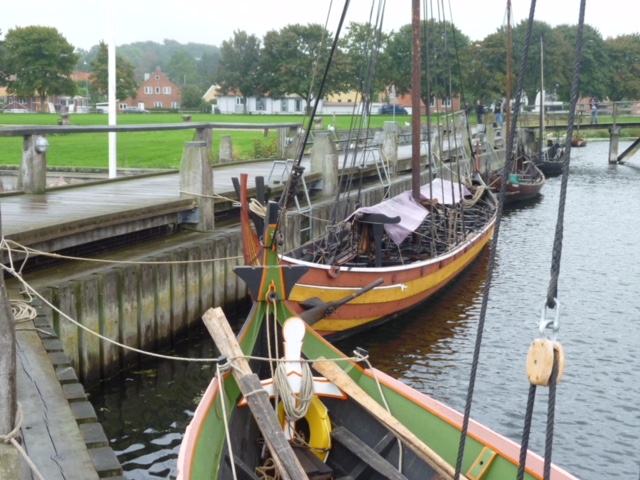
and they even take the ship out in the inlet and let people be the crew. The videos of this adventure make me think that it’s very strenuous, but exciting fun.
They are also building another replica, using only the tools and methods that the Vikings used — no saws, just axes, for example. They hope to finish this boat this year (I think). 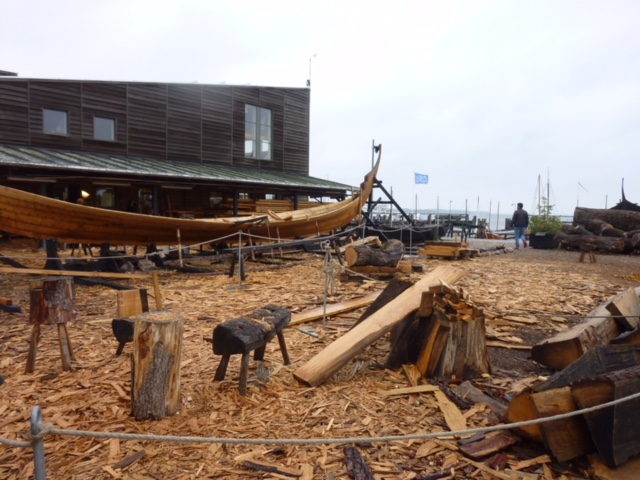
Now to the Oslo ships and their contents. I didn’t see any references to Egyptian tombs, but they sure seemed similar to me: honoring the deceased with treasures, and (perhaps even more) preparing him OR HER for life in the beyond. Two women, one apparently a very prominent older lady, were buried in this ship: 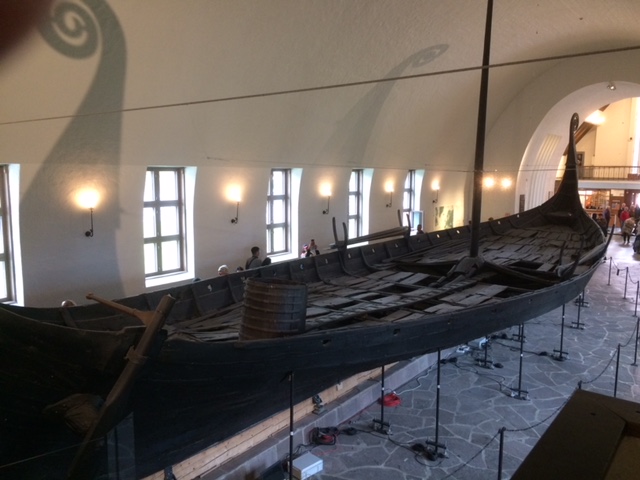
whose prow is more impressive than that photo shows: 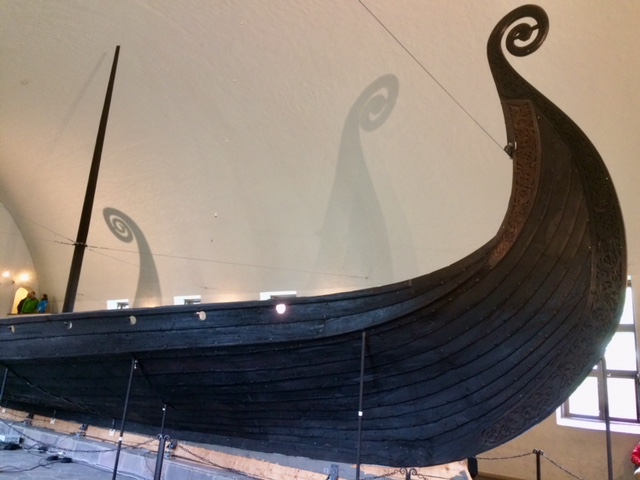
Here are the bones of the women, displayed in sparkly black stone that seemed (at least to me) very respectful: 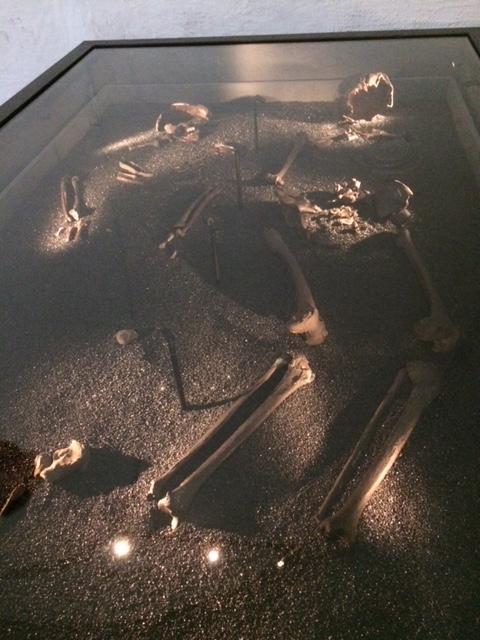
Maybe also a little bit macabre.
Only a small number of boards from this ship remained: 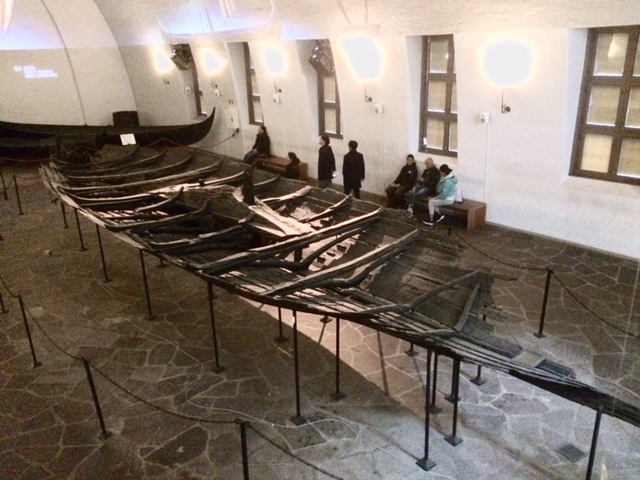
and I think this is what it looked like in the archeological dig: 
although I’m not sure that’s actually the same ship. But you can see why archeologists make the big bucks for such a hard job.
The objects of everyday life that were found with the people included a dazzling array that must have added to the height of the burial mounds: clothing, furniture, sleds, carts, horses, oxen, pigs, food, kitchen utensils, . . . and peacocks. Probably more. Viking-era tomb raiders apparently took the jewelry and weapons. Carved animals also protected the deceased from spiritual harm: 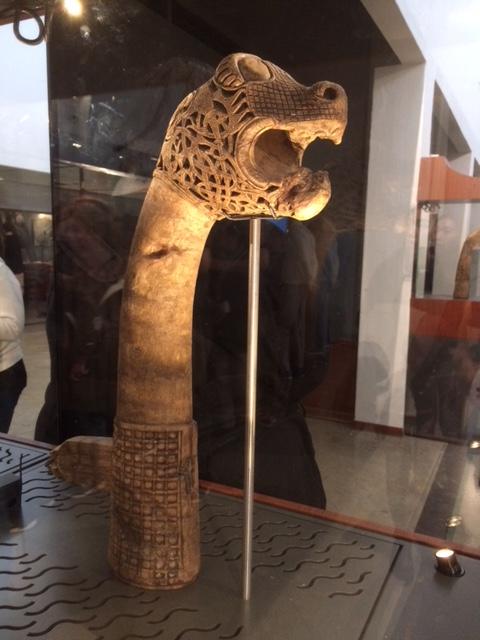
All of this made us think of an exhibit in the British Museum, though it’s from a 7th-century Anglo-Saxon burial site, a bit earlier than the Vikings. We liked it so much we saw it twice. I wrote about it in http://mostlymhb.blogspot.com/2014/06/vikings.html.
 The MHB Foghorn