Orvieto 11 October 2019
Instead of biking to the beautiful Lake Bolsena on a ride that had even steeper hills than the tour boss remembered, Dan and I spent the day walking around Orvieto, a better choice for us. The town is of course on a hill
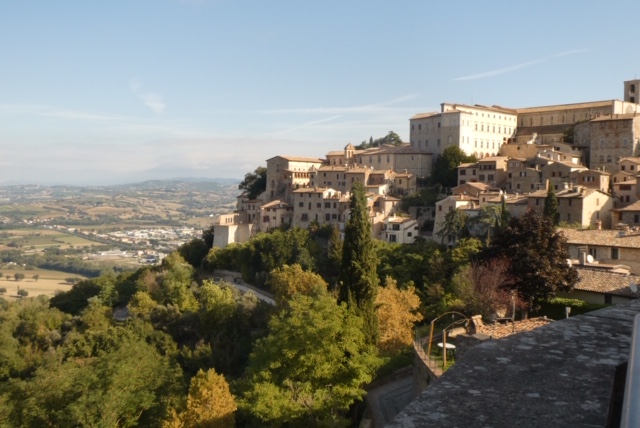
and the roads are so narrow that it’s Not Recommended to walk there from our nice lodgings. So we got one of the two taxis — two cars, not two taxi companies — to drive us up.
Orvieto is probably best known for its majestic cathedral, quite amazing for a small town in such a relatively inaccessible location. I think its facade is the tallest in Italy at 54 meters, and it was stunning in the sunlight:
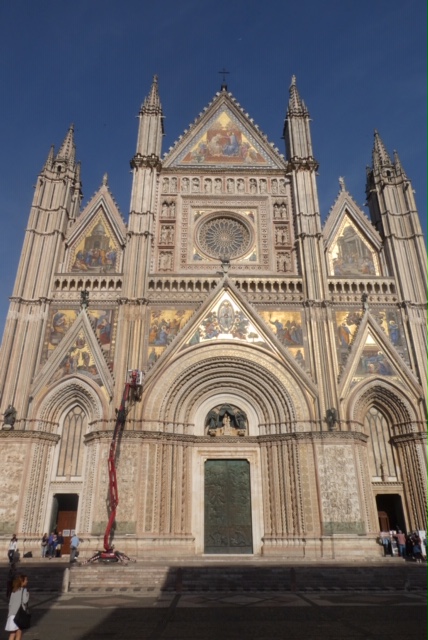
even with the guy on the cherry-picker who was blowing dirt off the facade.
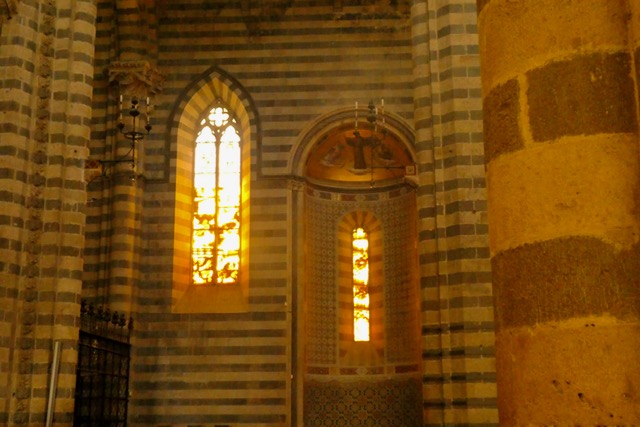
Inside, the church is less glorious, with only fragments of the original frescoes still on the walls. But the windows are beautiful, and I especially liked the combination of stained glass and alabaster. This photo doesn’t do justice to either, but I hope you get the idea:
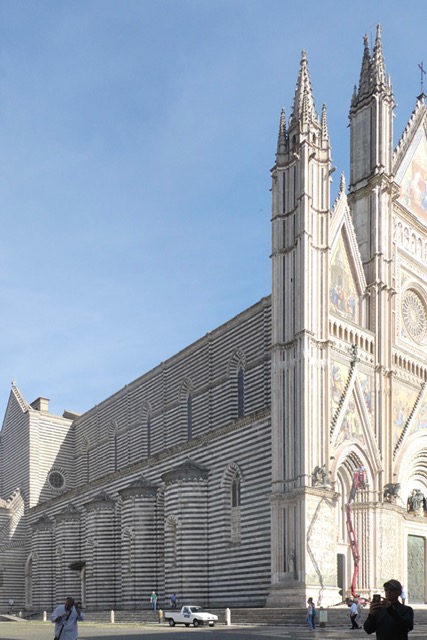
I also like the stripes of alternating basalt and travertine, although it develops something of a jailhouse look in the external walls:
Orvieto is built on tufa, a rock resulting from a zillion years of compaction of volcanic ash. Its recorded history goes back at least to the Etruscans, who were very clever about things like access to water sources. There are at least two Etruscan wells that one can visit. One has been somewhat reorganized to illustrate how it was used over the years, and we were interested in this chamber, which may need some explanation. First, try to see it as being about 20 feet deep, with a steep staircase:
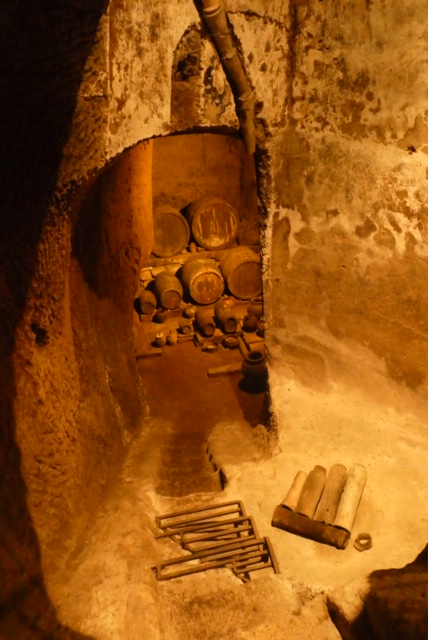
It was originally an Etruscan cistern, in which eels were used to stir up the water to keep it clean and to eat the insects that might be present. (I don’t know the answer to the obvious question.) Because it was dark down there, the eels became blind and white. Huh. Much later, the chamber was used to store wine barrels, and the staircase below the metal ladder has wide sidewalls to make it easier to roll the barrels up and down.
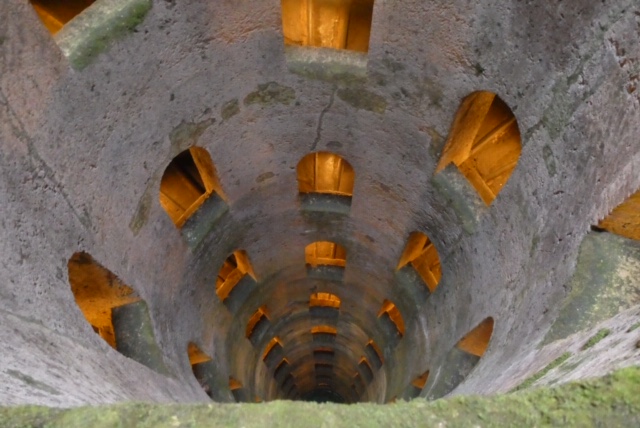
The other Etruscan well that we saw is a very deep cylindrical pit, with two staircases — one for going down, and one for coming up — supposedly to keep the mules bringing the water from running into each other and balking. As we were told more than once, there are 248 steps in each direction, but I’m sorry I don’t know the depth in feet or meters. There are windows in the walls to let outside light into the staircases, and with modern illumination it’s actually kind of pretty:
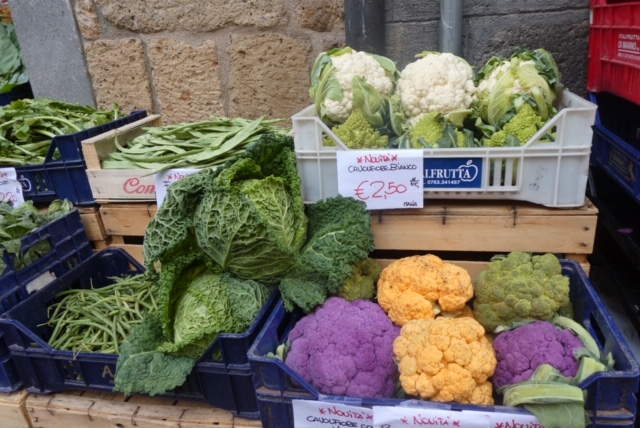
Finally, some bright colors. I keep thinking that I’ll stop taking photos of fresh foods in markets, but I could not pass up these cauliflowers:
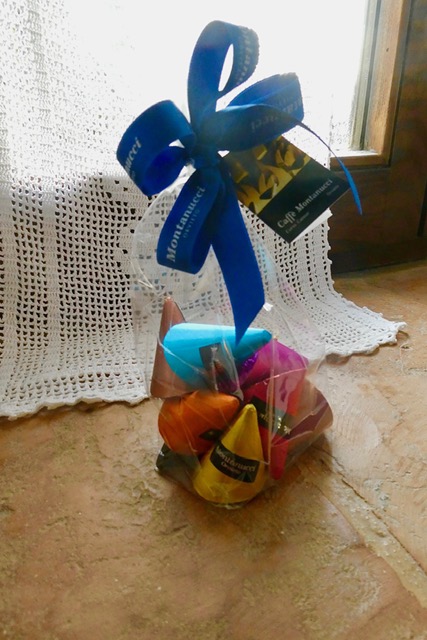
and the wrapping of these gift chocolates was also very fetching:
 The MHB Foghorn