Brittany, 15-16 October 2019
It has rained a lot since our arrival, dampening but not ruining our experience. We have driven to two cities of some note, and had some good walking around despite some showers. Both cities seem to be thriving, with lots of commercial activity in addition to tourism.
I had seen the name Quimper before, and probably actually knew that it is in Brittany, but I wondered how to pronounce it. Side track: the Breton language, Breizh, spoken here much longer than French has been, is unlike anything I know about. It’s on all the signposts, so we see it frequently, but wouldn’t try to pronounce it any more than we try Welsh or Finnish. So as we started learning about Brittany, I wondered if Quimper would sound French when pronounced properly. Short ending to long story: yes, it’s “cam-PARE,” just as it should be.
The cathedral of St. Corentin is here, and it’s very impressive:
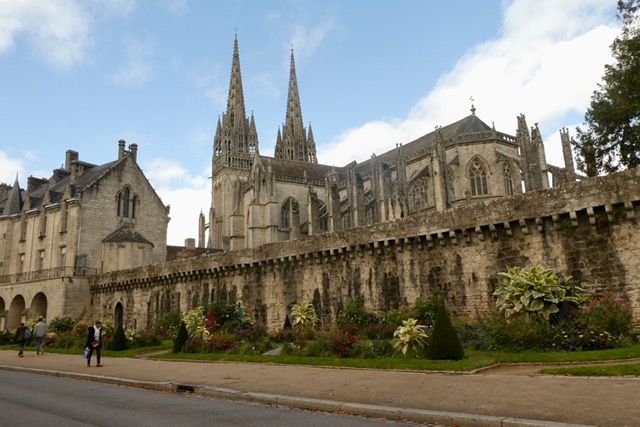
Can you see the flying buttresses? I love flying buttresses. I also love to find old but lively faces, and the choirs of churches are a good source. I’m not sure what this is trying to tell the faithful, but I like it:
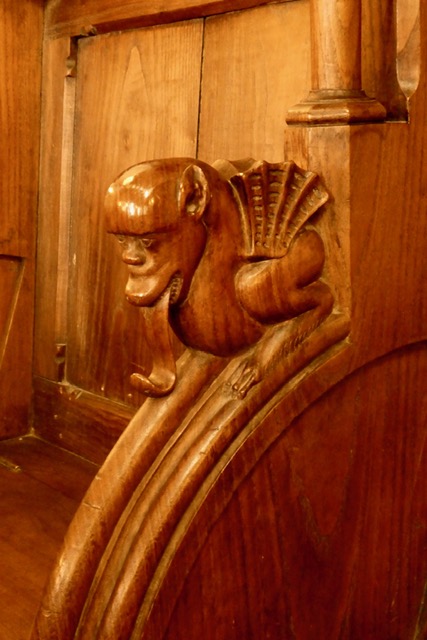
Be sure you see the tongue.
Quimper has some well-preserved half-timber houses, most with upscale shops on the ground floor, like this:

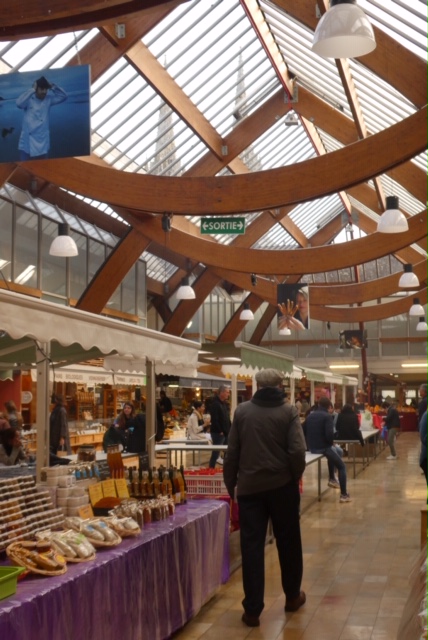
There’s also a very stylish covered market:
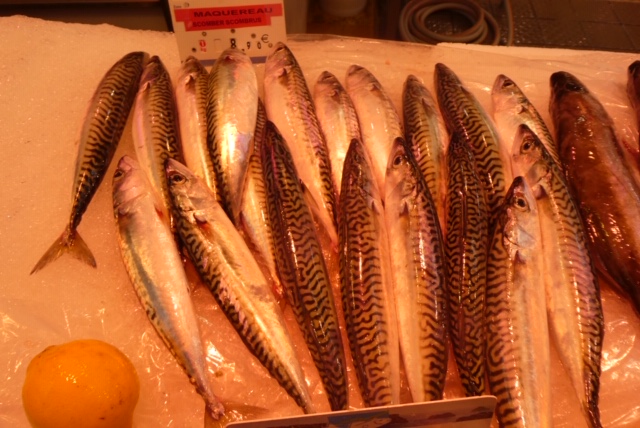
with (as always) very photogenic fish, like these mackerel:
In case you didn’t see them in the earlier photo, here are the flying buttresses again:
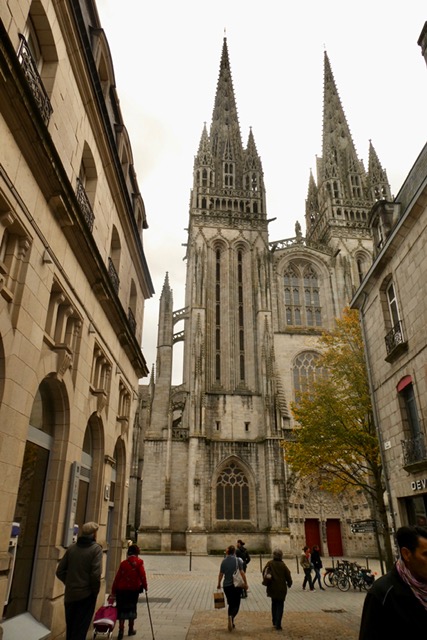
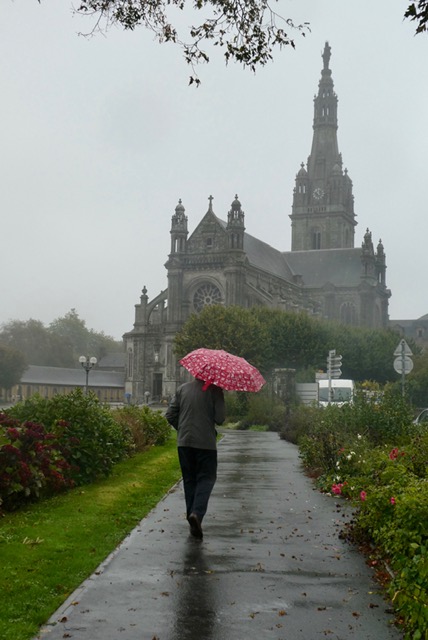
We also drove in the opposite direction to Auray and Vannes, in much more rain. St. Anne, the mother of Mary, was near Auray and asked a plowman to build her a church. The result is reportedly the second-most popular pilgrimage destination in France, after Lourdes. Here is a pilgrim approaching the church:
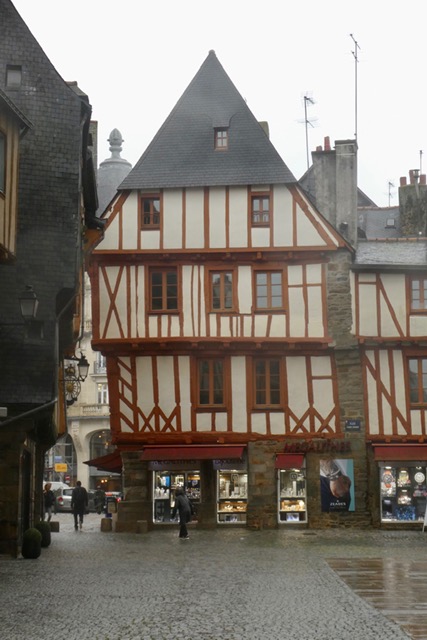
Vannes is not far from Auray, so we continued our drive and slosh. I didn’t take my usual plethora of photos because my camera is not underwater certified, but I have to show you two half-timber buildings that just feel more fragile than those in Quimper. First, this photo is really on the level:

and this nearby building is also for real:
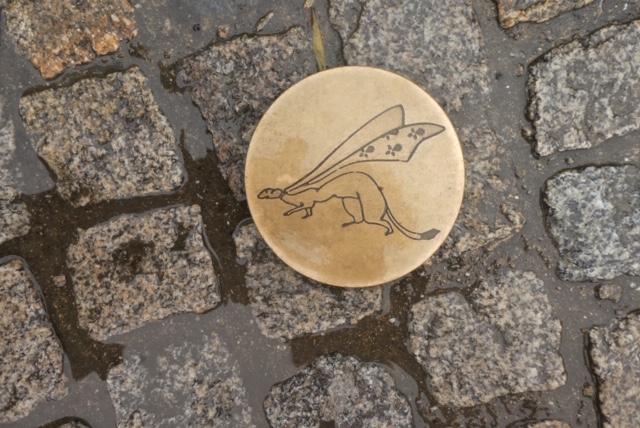
Finally, at various places in the pavement we saw this emblem of Vannes, which we first described as a flying weasel, but it’s really an ermine with a scarf including figures from the local (old) flag:
 The MHB Foghorn