Bayeux, 20 October 2019
The word “tapestry” doesn’t have to mean a huge dense square of cloth hanging on a huge dark wall, full of secular and religious figures in a scene difficult to decode. (Why are those hunting dogs lying beside the goddess, anyway?) The justly famous Bayeux Tapestry is nothing like that. See https://en.m.wikipedia.org/wiki/Bayeux_Tapestry for the story, because I won’t get it right in enough detail, and I don’t have photos of the real thing.
The tapestry tells the story leading up to the Battle of Hastings in 1066 when William the Conqueror came across the Channel from Normandy, defeated the English, and became King of England. That’s a pretty important event in European history, if you think about it. One wonders what would have happened if Edward the Confessor had had a male heir . . .
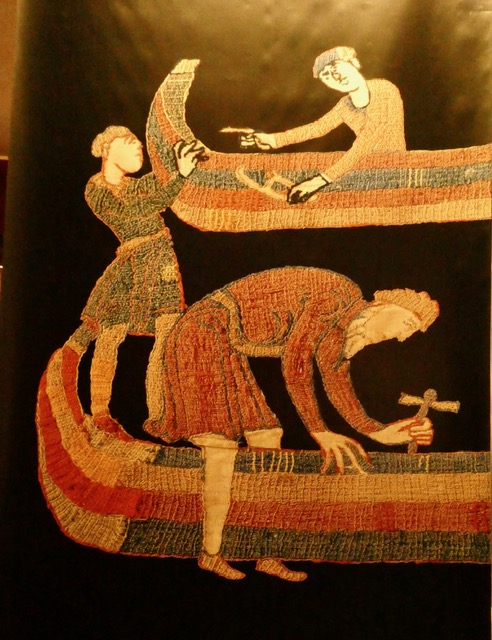
The museum at Bayeux presents the tapestry very well: an audioguide takes you along the >200-foot length of the 3-foot high wool-embroidered linen band at a comfortably quick pace, then you have all the time you want in an exhibition room with lots of detail and context. Photos are allowed in that room, where a few scenes from the tapestry are enlarged and printed on black, like this one, showing the carpenters building one of William’s large Viking-style boats:
Here’s a lively battle scene:
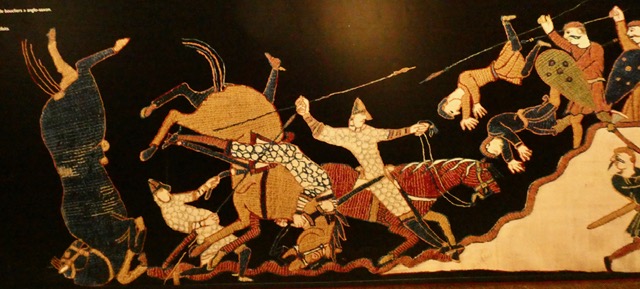
Calling this 900 year-old work a “cartoon” (as guidebooks do) feels seriously disrespectful, but it really is very animated. If you have the slightest interest in history, medieval architecture, warfare, storytelling, boatbuilding, horsemanship, haircuts, fabrics, or embroidery, this is the cartoon to see.
Also in Bayeux is a cathedral reportedly as big as Notre Dame in Paris. Perhaps because it’s right on the street, with no giant plaza around it, its size was hard for me to grasp. I’m not convinced that this photo gives the right feeling, but I’ll try:

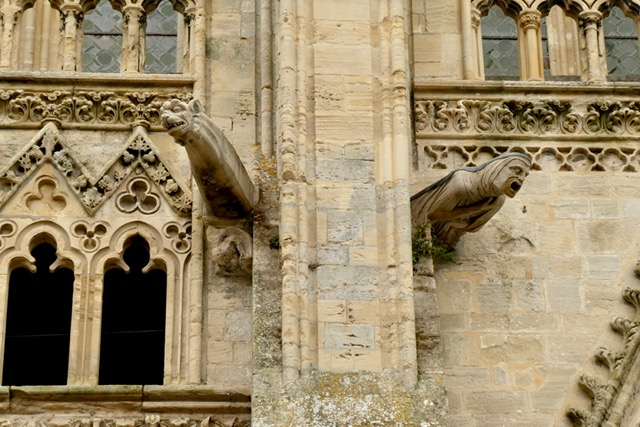
Please note the flying buttresses that are clearly visible on the right. I also love gargoyles:
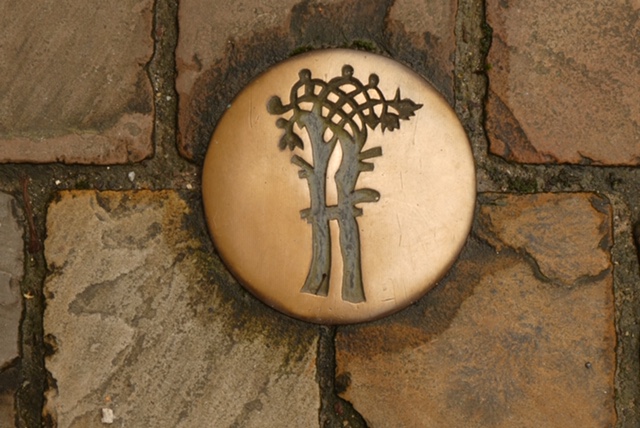
Finally, another nifty medallion in the street, similar to the ermine in Concarneau. This woodsy symbol was in the tapestry somewhere, and it’s now quietly in the street where it can be appreciated even on a rainy day with no audioguide:
 The MHB Foghorn