Mont St-Michel, 21 October 2019
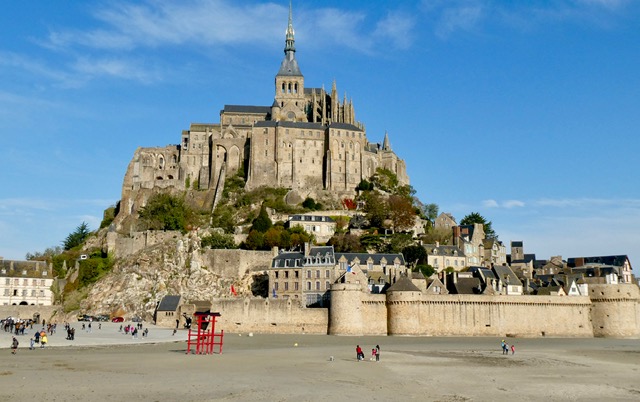
You have all seen photos of it, and many of you have been there. We were there on a beautiful fall day. There were enough other tourists to crowd the narrow cobbled street past the restaurants and trinket shops, but not the summer hordes that must make said street impassible. (Memo to self: off-season has its benefits.) You take a shuttle from the parking lot to the island itself, and as you approach by foot you see the standard (lovely) view:
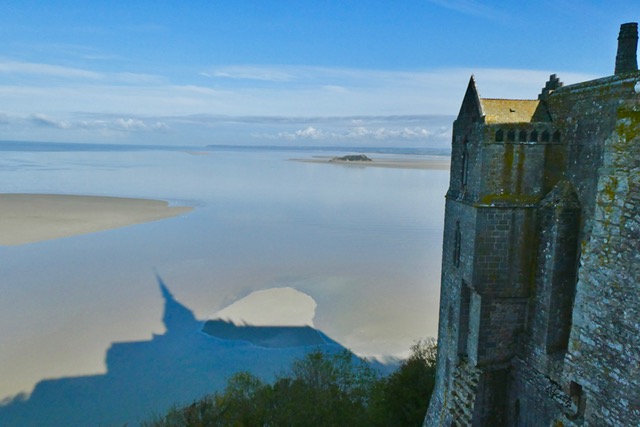
We were there at a good time to get a different view of the wide flat sea and some of the steep walls. The shadow makes this one of my Mood Shots:
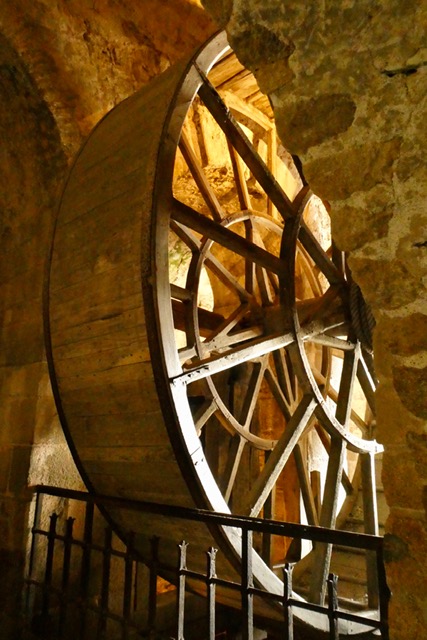
It was news to us that, between about 1789 (when the Revolution dissolved the religious community) and 1863, the abbey was used as a prison. (In your face, Alcatraz.) This giant wheel hoisted provisions from one level to another:
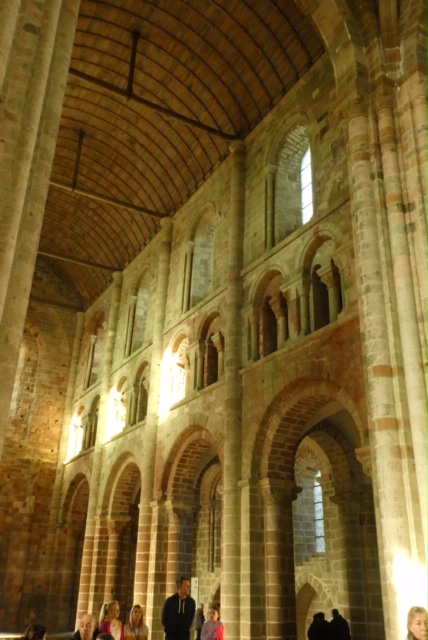
The abbey church itself surprised me with its simplicity. The windows have no stained glass, and there is no decoration or statuary:
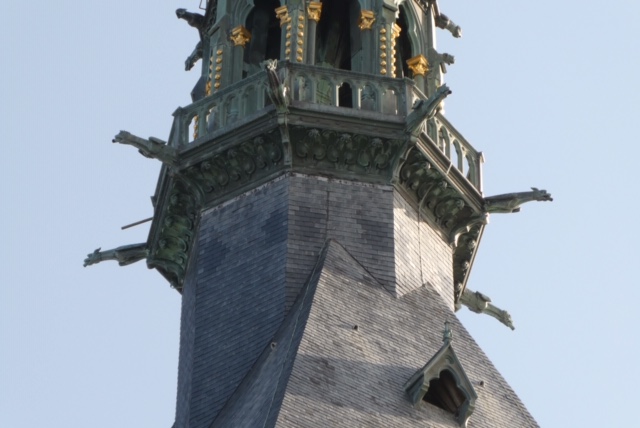
But there are gargoyles high up on the spire:
Utah Beach and Pointe Le Hoc, 22 october 2019
Another day’s drive took us to the excellent museum at Utah Beach and the monument on the cliffs at Pointe Le Hoc, on Normandy’s northern coast. It’s pointless for me to describe the history of the D-Day invasion, because there’s just too much. We were very impressed by the immensity of the undertaking, the intricate planning and coordination of Allied forces (air, sea, and land), the serious fortifications constructed by the Germans (using much forced labor), the deprivations of occupied France, and the tremendous importance of success. (What if William had not conquered England? Well, what if Operation Overlord had failed?)
A feature of the Utah Beach museum is the number of exhibits that focus on individuals, describing each man’s participation before, during, or after the invasion. I didn’t know that Antoine de Saint-Exupéry, author of “The Little Prince” and other books, had flown with the Allies during the war. Part of his “Letter to an American” is shown, and I found it both inspiring and depressing, given things today. See http://www.phitar.com/stuff/articles/saintex.html for the whole thing; here’s an excerpt:
One day, perhaps, more or less important differences will rise between you and us. Every nation is selfish. Every nation considers its selfishness as sacred. Perhaps your superior material wealth will allow you to grasp, today or tomorrow, advantages which we will perceive as unjust. . . . I will always bear witness to the quality of your values. The mothers of the United States did not sacrifice sons in pursuit of material gains. It is not for the benefit of material gains that these boys have accepted the risk of death. . .
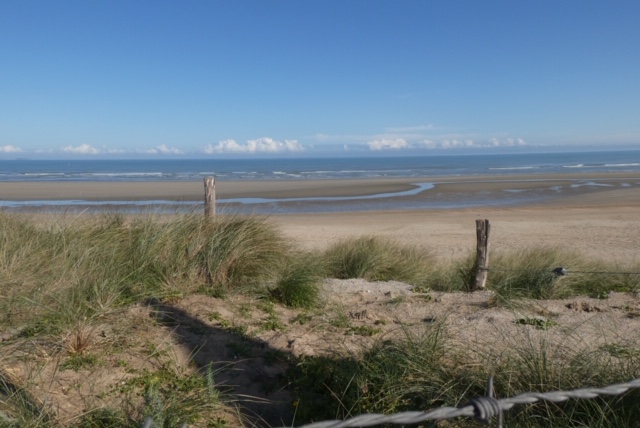
The beach today is peaceful:
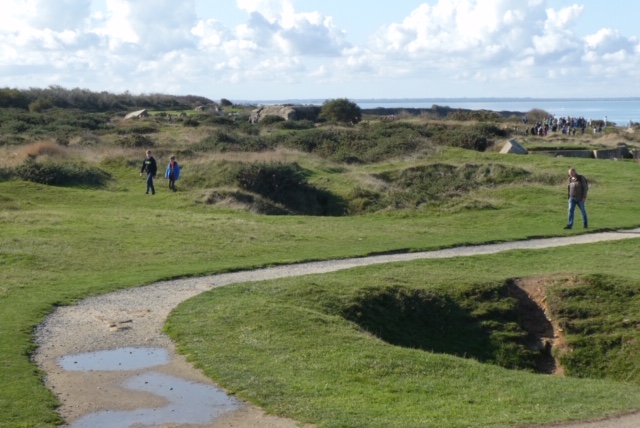
But the monument at Pointe Le Hoc is not a museum — it’s also one of the landing sites, and you can still see the signs of war. The German fortifications here would have been able to fire on both Utah and Omaha beaches, so the Allies had to clobber them. Before the invasion, huge numbers of American bombs were dropped for weeks, damaging many of the large gun batteries and machine-gun nests. The results are still visible, as the area is now full of craters:
The bombing did not eliminate the risk entirely and some bunkers remained. So American Rangers climbed up the cliffs
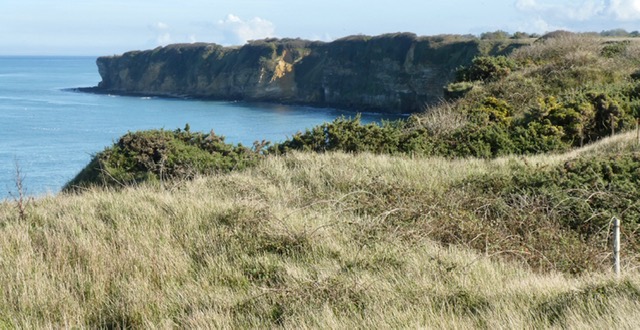
to disable the last of the German guns. It’s not hard to see why these were called pillboxes:

and it’s sobering to see this evidence 75 years later.
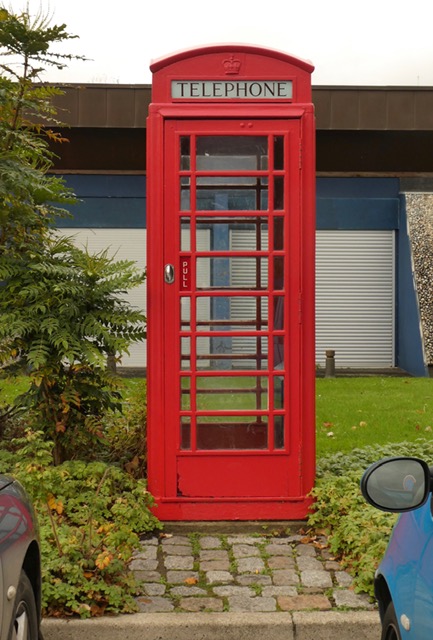
Normandy seems determined never to forget. We visited another invasion museum, this one in Bayeux, which was the first city to be liberated. On the streets leading to the museum, pictures honoring soldiers and sailors are hung on the lightpoles, and the signs of gratitude to the Americans, British, and Canadians are everywhere. My personal favorite ends this post. As you approach the entrance to the museum, this is just standing there quietly, I guess as a reminder of a place not that far away:
 The MHB Foghorn