Sunday-Monday 6-7 october 2024
After the excursion to Valparaiso, the group returned to Santiago. Some of us stayed in Chile for a trip to Patagonia, beginning very early on Saturday for a flight to Punta Arenas. From there, a ~5-hour van ride brought us to the national park of Torres del Paine. Our hotel is at the base of the Paine Massif, dramatic mountains that make you feel as though you’re at high elevation, though it’s actually only around 2,000 feet, and I think the peaks are at 7,000-9,000 feet.
Patagonia is known for its mighty winds: a local nickname is “the broom of God.” This wall of our hotel room is an accurate picture: any vegetation more than a foot high is permanently bent by the wind, which accelerates as it squeezes through some of the mountain passes.

Not to harp on the wind, but . . . this sign on a walking trail is not about fire danger

and a sharp-eyed member of our group noted that the arrow indicating wind speed had apparently blown away.
Some people are just very lucky <repeat>. We had two full days with very little wind, lots of sun, fabulous mountains, and good guides. (As I write this, it’s raining in Torres del Paine for the next few days.) We were happy to have our hiking sticks, but the trails were good, and we didn’t do anything very strenuous.
The group had a little contest of thinking up adjectives to describe what we saw. Contributions included stupendous, fabulous, awe-inspiring, rad [sic], unique-alicious, breath-taking . . . you get the drift. All quite reasonable.
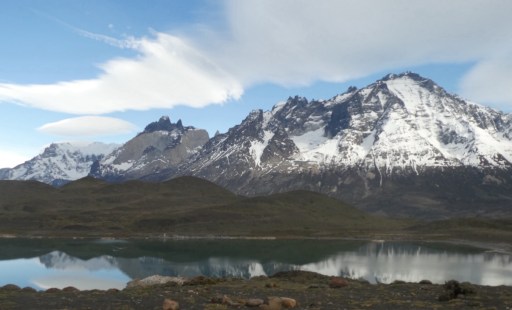
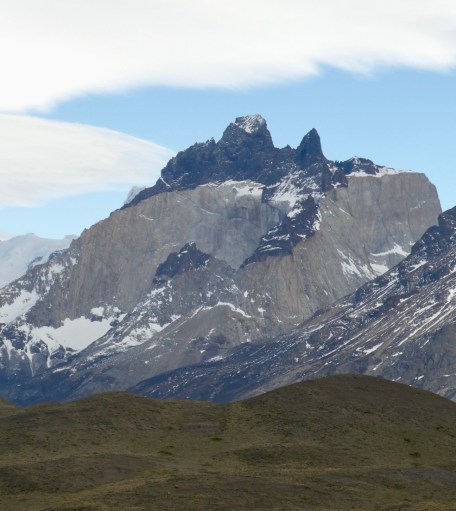
One can easily see that the three-horned peak is composed of three types of rock: sedimentary at the bottom, igneous in the middle, and metamorphic at the top. Geology is fun.
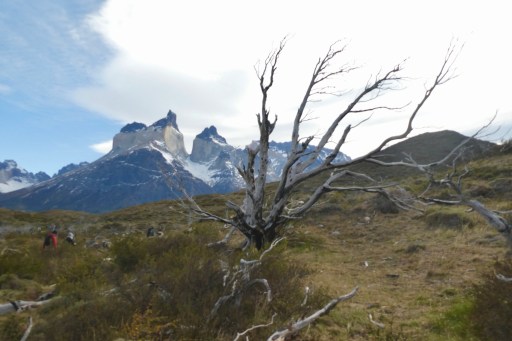
There was a serious fire in the park about ten years ago, driven fiercely by the wind. Argentinian firefighters came to help contain it as it roared along for 20 days, consuming tens of thousands of acres of this scruffy grassland and forest higher up. The wood of the legna tree is very hard, and the tree grows very slowly. Bleak remains like this made us sad:
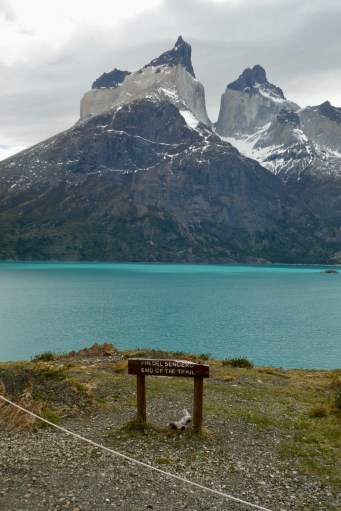
Patagonia is very far south. We didn’t fall off the bottom of the continent, but we did have to turn around and go back from this particular point, according to the “End of the Trail” sign.
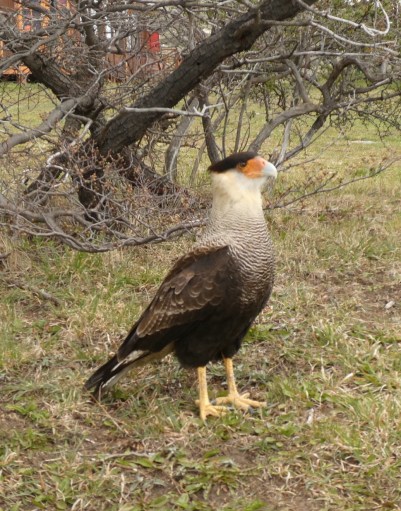
Finally, for this time around, we had a guest at our outdoor lunch— the cara-cara bird.
 The MHB Foghorn