Saturday-Sunday, 8-9 November 2025, Varenna
We left Milano from the big busy Stazione Centrale,

taking a crowded train for a bit over an hour to Varenna, a town with a small permanent population, on the shore of Lake Como. Long ago it was a fishing town, but today its main industry is tourism. The train arrives once an hour, disgorging both day-trippers and people like us who will spend a few nights.
It’s pleasantly chilly, and we’re happy not to have any rain. Unfortunately the air is quite hazy, making stunning photos of the view impossible. Still, some fall color remains in the pretty town.
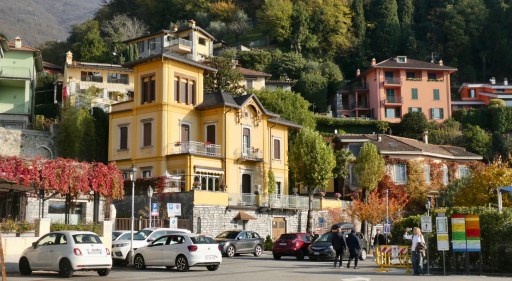
We took a long walk on a narrow pathway just above the water, past boat docks on one side and an endless succession of small shops, restaurants, and bars on the other. It did not seem to be the off-season, but it was a sunny Saturday in the fall, so maybe the crowds are not surprising.
After orienting ourselves, we chose a restaurant for dinner, and had one of the most beautiful meals ever. The octopus starter
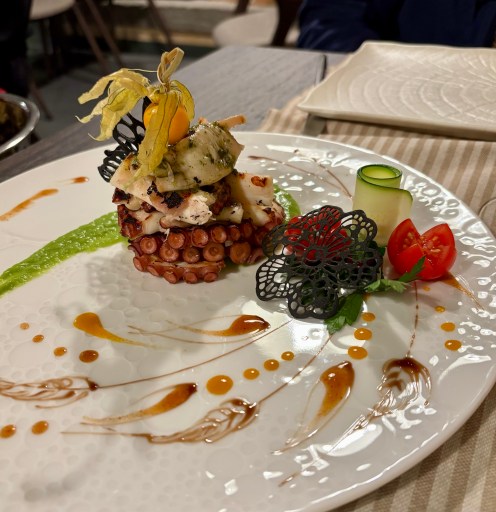
was not the only dish whose plate was decorated with bright dots and swoops of sauce. I enjoyed filets of six different fish all caught locally.
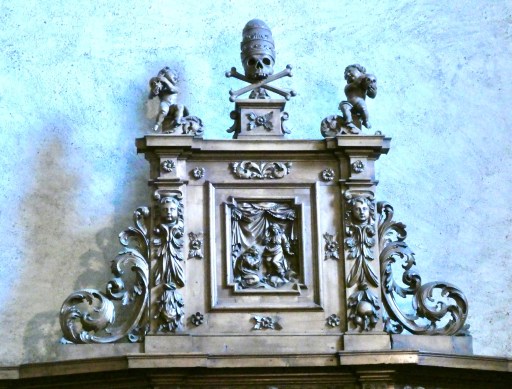
On Sunday, we walked again, up to the town square to see the small church of San Giorgio, built in the 13th century. Our guide book says that many destination weddings are performed here, which is nice. But in such old churches we always seek out reminders of mortality, as in this elaborate carving above the confessional. You may need to zoom the cherubs at the top to see the objects of their adoration.
Moving on from the very old church, we passed a much more recent, apparently huge, parking garage that we assume accommodates the day-trippers who don’t arrive by train. Directly across the road, clinging to the steep cliff above the lake, is the Villa Monastero, once a women’s convent, now a museum and extensive garden. We had a very pleasant walk along the path that snakes down through narrow terraces above the lake. The trees and plants are very well maintained and detailed signs in Italian and English describe the many species.
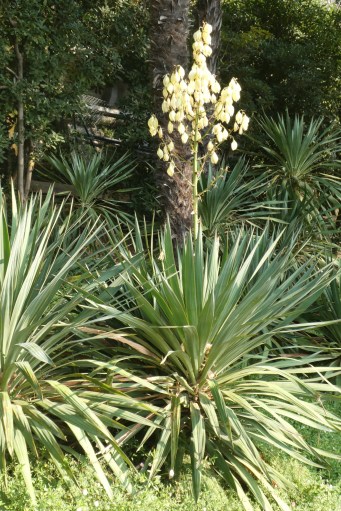
The climate here is very temperate, supporting plants usually associated with areas farther south. It was fun to see big grapefruits and clementines on the trees

as well as yucca-like plants that seem out of place but very happy here
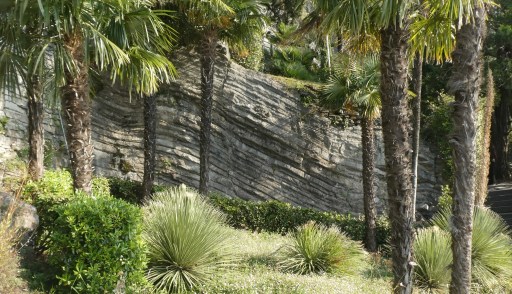
My knowledge of geology is superficial, so maybe I should not have been surprised to see this kind of rock formation above a glacial lake, but whatever . . .
I’ll leave it there for this post.
 The MHB Foghorn