Saturday, 28 september 2024
We started the day by heading toward Cerro San Cristobal, a very steep hill. There’s a zoo about halfway up, and a large park at the top, including picnic areas, swimming pools, and a cultural center.
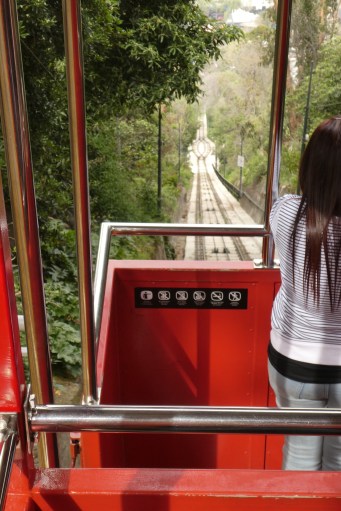
We didn’t spend much time in the park, but we definitely enjoyed the funicular ride up and back down the hill. It’s really steep. It’s impressive that one can walk all the way up, and quite stupendous that we saw bicyclists making the trek.
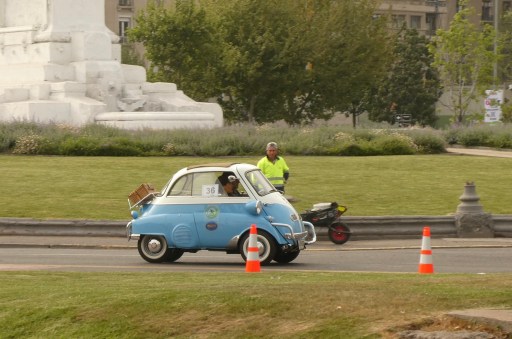
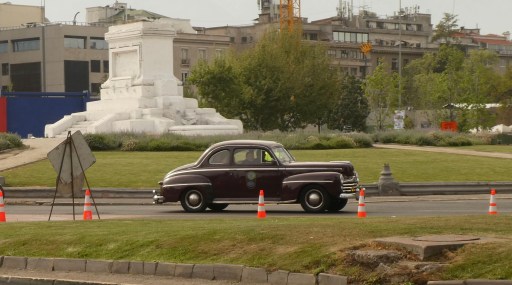
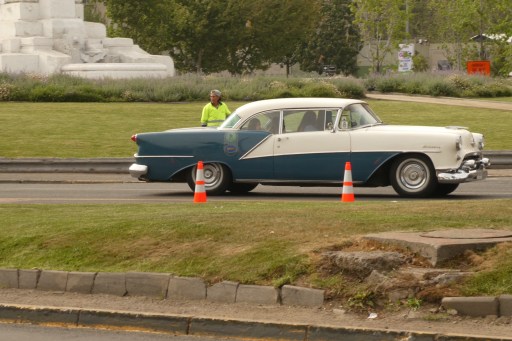
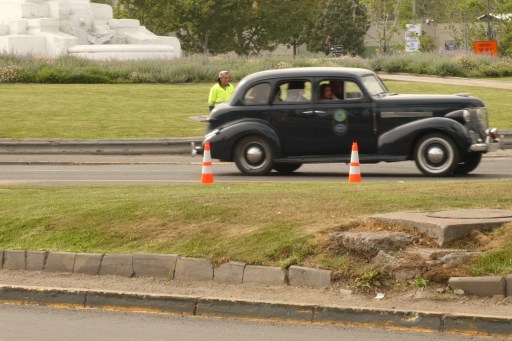
On our way to the hill, as we approached a major boulevard, traffic was stopped for a few minutes as a stream of vintage vehicles drove by. I caught only a few:

People in every big city have all kinds of ways to make money. We were not at all charmed by a guy with a loud boombox playing pop music on the metro, but other performers were much more entertaining. This juggler performed in the intersection during the long red light, collecting from drivers just before the light changed. He used his hands, shoulders, head, kees and feet to keep the balls in play. Very fun.
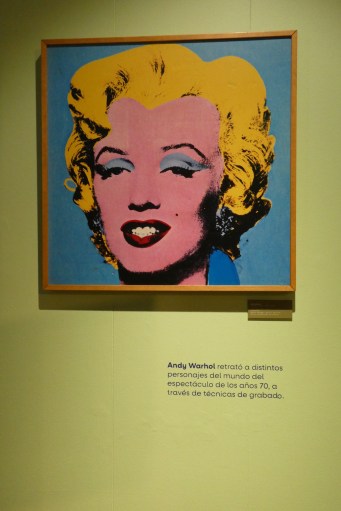
The Quinta Normal is another big park, with many museums nearby — Science and Technology, Natural History, etc. We made a short visit to the Museo Artequín, a museum for children. It’s in a building that originally represented Chile at an 1889 exhibition in Paris, then was taken apart and reconstructed here in Santiago. It has a small collection of reproduced artworks with observations about light, color, sense of movement, and very brief summaries about the artists’ work. Here’s an example.
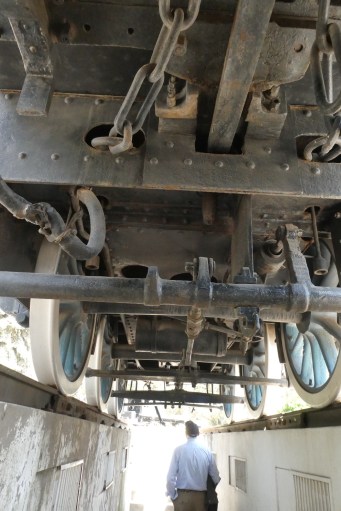
The nearby Museo Ferroviario is a collection of steam locomotives and a couple of passenger cars, most of them used in cross-Andes transportation around 100 years ago. Here’s the underside of one locomotive. We tried to follow the transfer of power from engine to wheels, but failed.
All of those sights were fun and interesting. The sobering, deep-thought museum of the day was the Museo de la Memoria y los Derechos Humanos — just call it Human Rights. In 1973 a full-out coup d’état bombed the presidential palace, shot President Allende, and put power in the hands of a military junta. Before being overcome in 1990, the dictatorship killed about 3000 people, while many more were tortured, imprisoned, or exiled. This impressive museum documents those years and people. Displays of official papers, newspapers, letters, videos, posters, and photos illustrate the horrors of the dictatorship, the world’s reaction, and the opposition groups that eventually restored the government. A truth and reconciliation commission was then established to discover and record as much as possible about the atrocities committed against Chile’s people.
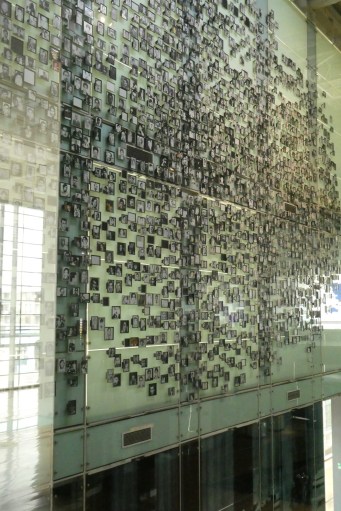
One large wall is covered with photos of known victims. In a small alcove with symbolic lighted candles, visitors can look up a person’s name to see if anything is known about him or her.
Augusto Pinochet, leader of the dictatorship, is not prominently featured in the museum, though of course he appears in photos of the ruling junta and in newspapers; his contribution to history is not hidden. But there’s a separate exhibit about the 1990’s scandal of an American bank holding his money. This exhibit presents a satirical view of the scandal, and we liked this cartoon of Pinochet’s l’état-c’est-moi coming undone.

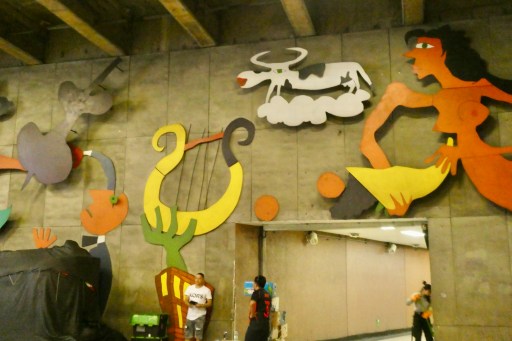
Finally, an example of the art in the metro stations, which is in various styles, with no similarity among the ones we’ve seen. This is our local Tobalaba station:
 The MHB Foghorn