2 september 2023, Lyon
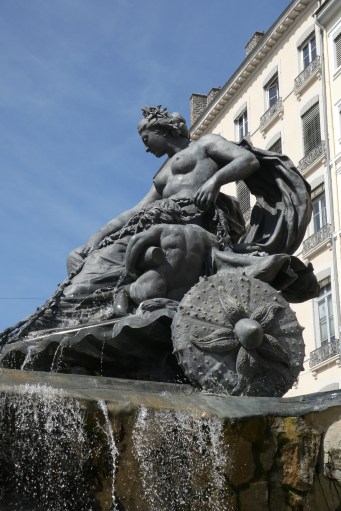
Being in Lyon is really fun, if only for its history and pride. You also learn things just by looking. Here’s the French icon Marianne, driving a chariot of four horses. Now I know that seashells — really big seashells — can serve as wheels. (The sculpture is by Bartholdi, who also created the Statue of Liberty.)
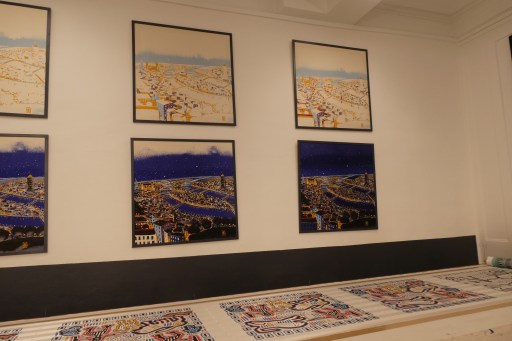
We walked to a silk workshop, which may just be a come-on for the salesroom upstairs, but I don’t care. On the wall you see the stages of production of a night view of Lyon. On the table is a different print in progress. It’s very exacting work, as each successive screen, through which one color is laid down, must be placed in just the right location on the print-so-far.
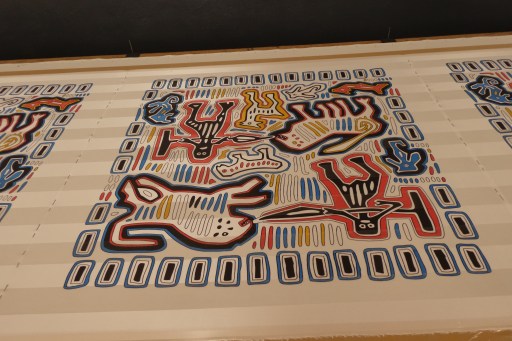
And here’s a print-so-far, ready for the next color to be added.
Lyon’s silk industry was a big deal in the 19th century, and the House of the Silk Workers was high on the list of sights for this trip. (We happened upon a silk museum in Stockholm in 2018 and wanted more.) Although we didn’t learn a lot more about the production of silk, we now know that Louis Pasteur kinda saved the industry when an infection attacked the worms; he figured out how to identify and remove sick eggs.
Equally interesting was the history of the silk workers themselves. The government supported management when wages were effectively reduced, and there were at least two serious revolts by the workers in the 1830’s. Both were put down by military troops with many resulting deaths, but the city government did agree to some of the workers’ demands.
The aforementioned Maison des Canuts is at the top of a hill (or group of hills) called les Croix Rousses, named after the reddish soil, which must have been evident sometime. Given the heat, the metro was clearly the right transportation up, but walking down was not bad. It’s a long long descent, most of it paved as youcan see in this photo.

From silk printing, we moved on to the Museum of Printing and Graphic Communication, a long name for a rabbit-warren of rooms up stairs and around corners, illustrating everything from pre-Gutenberg woodprints and papyrus through many important evolutions in printing, including all those posters in the 19th century and newspapers, up to font design and desktop publishing.
Some of this was surprisingly exciting. Here is a page from one of the 49 known instances of the first book published in Europe, using Gutenberg’s technology. It dropped in the 1450’s.
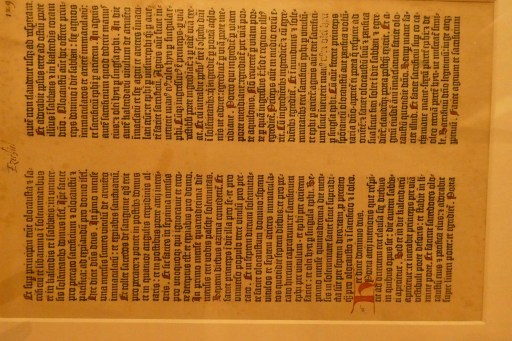
It’s a complete Bible, of something over 600 pages, each with two columns of 42 lines.
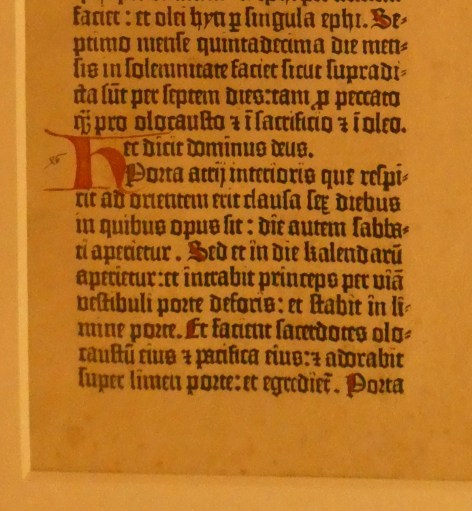
This little chunk of the page is easier to see and perhaps read (for all you Latin scholars) Note the initial letter in red, added by hand after the page was printed.
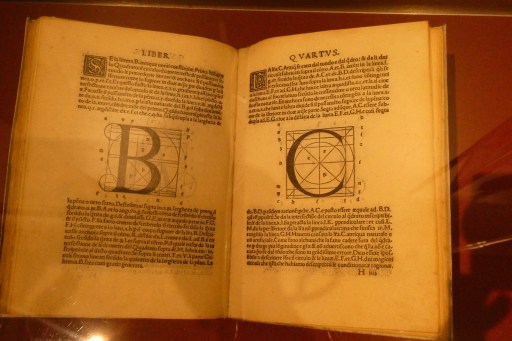
Font design is important to printed communication, and the museum has a whole little section on Gothic, Garamond, Baskerville, italics, and other designs invented a long time ago..
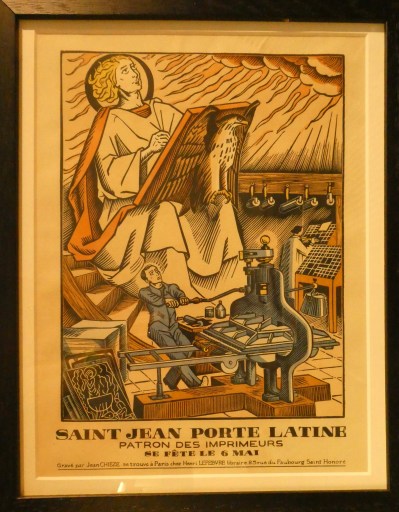
I couldn’t resist this poster from (I think) the early 20th century. May 6 was declared the commemorative day of St. john Porte Latine, the patron of printers, typesetters, and lithographers. Sorry I don’t know more!
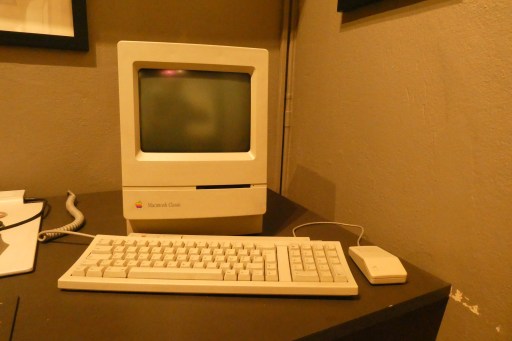
Finally, (though I’ve skipped huge amounts — I really recommend this museum) we get to digital technology and all the major ways in which it has influenced printing and graphic communication. The device pictured here is well known to all of you. Apple and Adobe work is rightly noted, but for some of us, the fumbling of the future is obvious by its absence. Oh well.
 The MHB Foghorn