3 september 2023
On Thursday we were back on the trains. The first part down from Villars to Bex, on the way to Geneva, is steep enough to require another cog-wheel train. (When the route covers very steep ground, especially if it’s wet or icy, friction between wheels and tracks isn‘t enough to counteract gravity. One really wants the positive engagement between cogs and wheels.)
There are no cogs in the tracks along Lake Geneva and the train whizzes along as expected. I was lucky to snap the Chateau de Chillon as we zipped by.

The train trip from Geneva to Lyon was unremarkable, which is to say just fine. It was hot when we arrived, though not as crushingly so as it has been recently. After the usual confusion of finding the metro, and then the funicular up the hill, we were at the Basilica of Fourvière, near our hotel.
The Basilica was built very recently — only about 150 years ago — and its surfaces, interior and exterior, look as if they were polished yesterday. Inside, the gleaming gold mosaics make you want to put your sunglasses on. Here’s the bright ceiling.

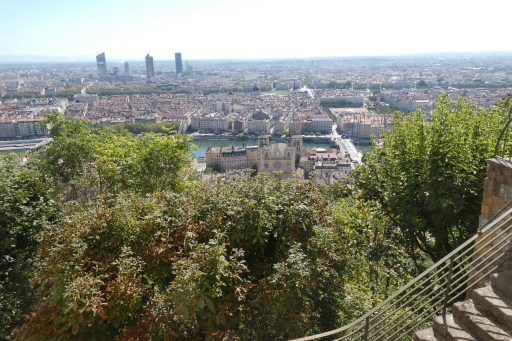
Lyon is the third-largest city in France, and much of it is on hills above the Rhône and Saône rivers. From the Basilica, located on one of said hills, there’s a nice view of the city and the Saône below.
Lyons was an important Roman city called Lugdunum, with a population larger than that of Paris at the time. A large museum full of artifacts is cleverly built into the hillside very close to the Basilica.
The amphitheater was uncovered only about 50 years ago. Find the square window near the center of this photo and the other window on the right side. They look out from the mid- and lower levels of the museum, whose entry is in the concrete level at the top.

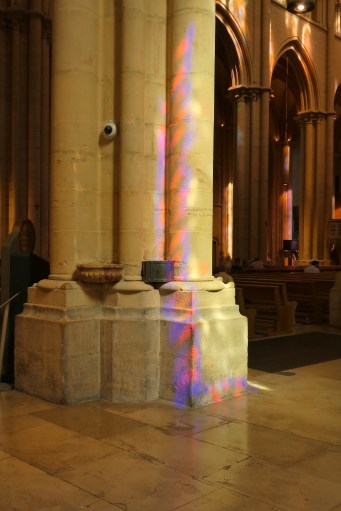
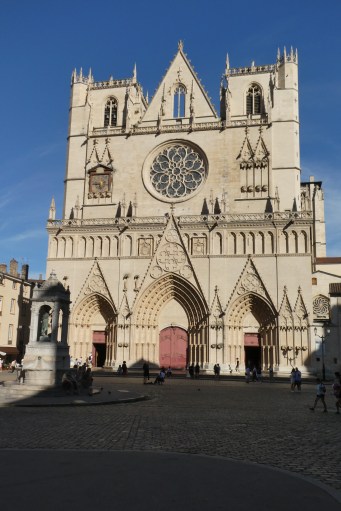
We left Lugdunum and descended by funicular to the medieval Cathedral of St. Jean (Saint John the Baptist), built between 1180 and 1476. I was not the only person caught by the sun shining through stained glass right at the entrance to the church.
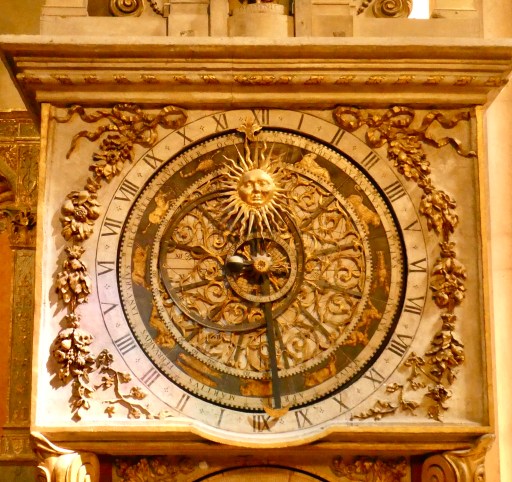
An impressive feature of this cathedral is a clock capable of calculating the date of the Catholic holidays, including Easter. It has four concentric dials, each with a pointer. Unfortunately, the clock has been stopped while renovations are going on, so even if I could read it I wouldn’t know if it was accurate.

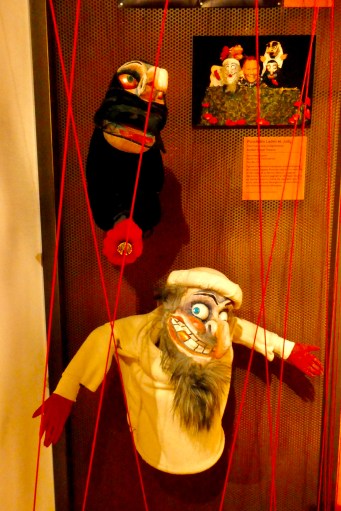
The art of puppetry has been a big deal in Lyon since the early 1800’s when an unemployed silk weaver created Guignol, sort of a French alternative to the Italian Commedia dell’Arte Pulcinello. There’s at least one good museum here, showing shadow puppets, marionettes, hand puppets, and lots more variety from around the world.
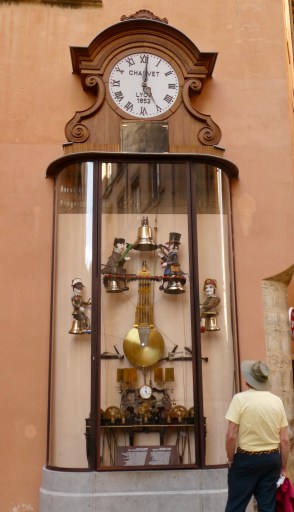
Outside, another fun clock. On the hour, the guys at the top clang their hammers to sound the bell.
 The MHB Foghorn