Thursday-Friday, 20-21 november 2025, Rome
On Thursday we started with a dose of relatively recent Italian history, namely the unification of the country, a.k.a. the Risorgimento. The Kingdom of Italy was created in 1861, and with the capture of Rome in 1870, the unification was complete and Rome was made the capital of the country.
We went to the Central Museum of the Risorgimento, located in the Vittorio Emmanuele II monument. For all the heroes of the movement and all the back-and-forth of military and political battles, this museum displays the story in a compact way.
In 1796, Italy looked like this —
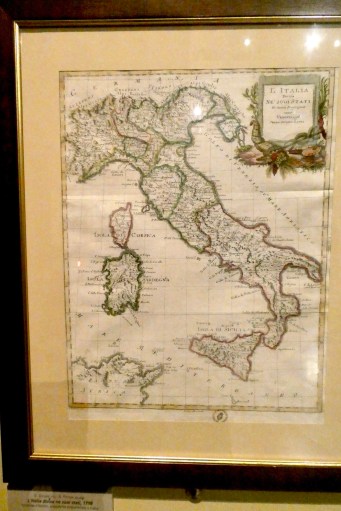
a jumble of states, owned, claimed, or dominated by separate powers including France, Austria, and the Papacy.
Italian patriots (Mazzini, Cavour, Garibaldi et al.) fought on the battlefields and in the halls of power, and the competing influences sloshed back and forth for decades. (Who knows what normal people thought of the changes to their so-called rulers?) Eventually, the patriots kicked out the foreigners, and took control from the Papacy. The afore-mentioned Vittorio Emmanuele II became the king of the unified country.
His huge marble monument dominates Piazza Venezia. When we arrived, it seemed that a ceremony for the Unknown Soldier was taking place, about halfway up the steps:
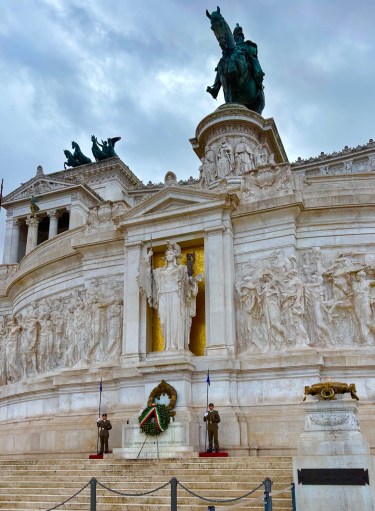
which I show you just to give perspective on this view from the street below:
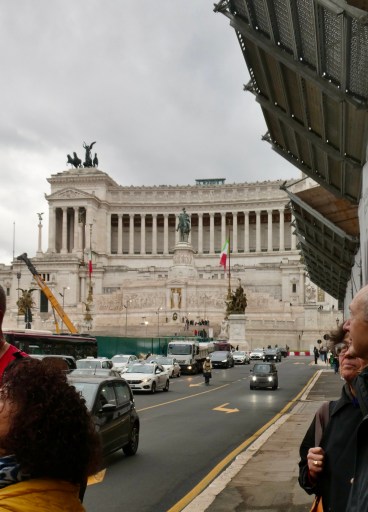
That photo is marred by the construction of a new Metro station, which has the whole piazza torn up. Traffic in the area is a mess, and a Google map of the walking route from wherever to the Risorgimento museum shows you loops around the piazza that make no sense. Until you see that no, you can’t go that way; go back around.
We’ve seen construction and renovation of ancient sites all over, which makes photos sometimes pointless. But it’s great to see these improvements — attention to both history and the future of the city.
On Friday, the main events were the Vatican Museums and St. Peter’s. Holy smoke. (Please forgive me.) I can’t fully grasp the size, extent, capacity, volume, or breadth of this complex of Catholicism. Altogether, one sees the work of thousands (?) of highly skilled artists and craftsmen, over many hundreds of years, resulting in edifiices and objects ranging from gigantic to tiny.
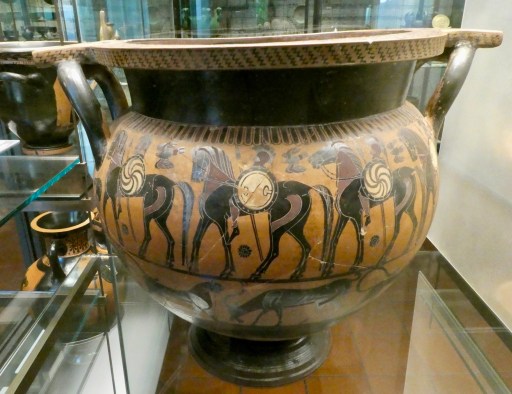
But we knew already that Rome has some great displays of Etruscan artifacts, dating to roughly the 5th century BC, and the Vatican Museums have a whole wing devoted to them. So we started there. I really know very little about this civilization, but I do like their black-glazed terra cotta:
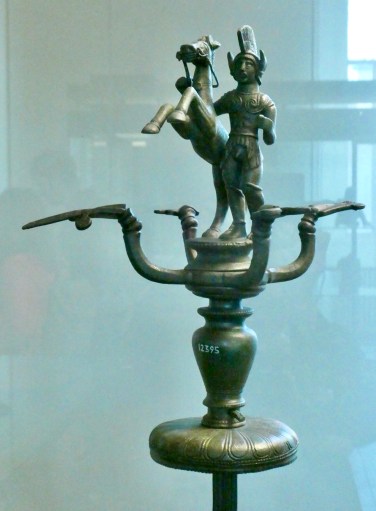
And this time I was struck by some tiny bronzes at the top of very tall candlesticks:
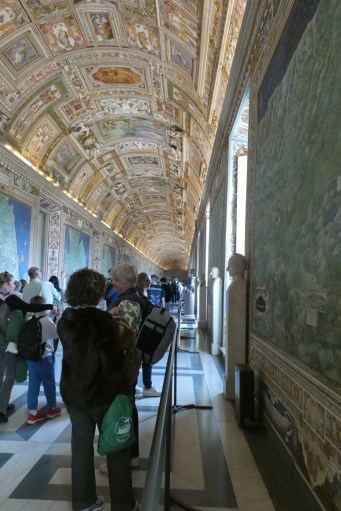
Switching gears to the greater vastness of the Museums’ other collections, we came into a giant hallway with maps on each side, showing areas of Italy in ancient and ~modern times.
I tried to get a sense of the length of this gallery in this photo, but I probably should have superimposed a football field for reference:
Passing through long galleries of tapestries, sculptures, church artifacts, and a contemporary art exhibit, we reached the Sistine Chapel. We were lucky to be able to sit and crane upward to admire the ceiling. I don’t think it makes any sense to call anything “the greatest single artwork in the history of the world,” but this might qualify. Find your own photos online; photography is not allowed in this sacred space.
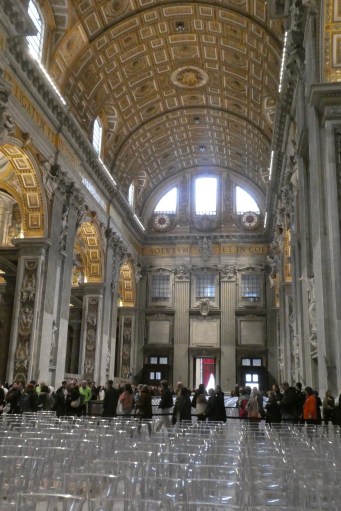
From the museums, we had a longish walk around the walls to reach Piazza San Pietro, then a wait among many (many) people to get through security scanning and into the huge square. We finally entered the basilica itself, and although I know it’s very large, I just cannot wrap my head around it. Each of the many hundreds of people (including us) in that building is nothing more than a mote of a mouse* in all that acreage and height. My photos can’t really convey the size, but here’s an attempt:
and of course Bernini’s baldaccchino over the altar:
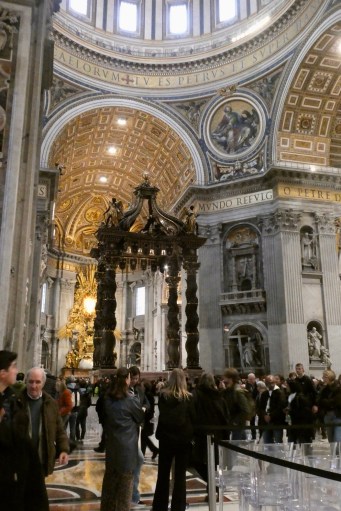
I know that St. Peter’s is big. But it’s overwhelming.
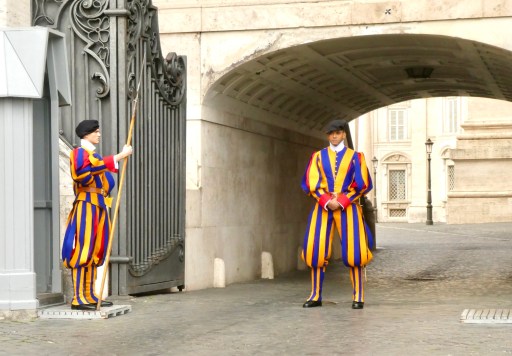
Fortunately, real-size humans can end this post:
- “a mere mote of a mouse” is from William Steig’s Amos and Boris, a book about friendship that I love.
 The MHB Foghorn