Sunday, 16 november 2025, Florence
On our previous visit to Florence, an early-morning power outage closed the Uffizi Galleries. When power was restored, we stood in line for an hour or more, waiting for the museum’s security systems to be rebooted. But we gave up and did something else that day. It feels quaint to think that we could have bought un-timed, non-advance tickets, in September, years ago.
This time, we bought tickets one day in advance, with only 48 still available for Sunday at 11. At the specified time, we stood in line to show said tickets (QR codes on my phone) twice. Then another line to send purse, jackets, and selves through the scanners, and finally a line up the staircase to the vastness of this museum’s collections. I don’t think it’s any more crowded during the on-season, because the tickets must simply sell out.
The galleries are long, and full of sculptures and paintings, with large rooms off to the sides, containing smaller works in innumerable glass cases. This shows you the building’s two wings stretching away from the river, with some other major landmarks nearby:

It took some effort to get a good view of the many (many) works that interested me, but it’s crass to complain about crowds, including impenetrable tour groups. (Thank goodness for those little microphones and earbuds that allow the leader to speak normally instead of shouting.) So no complaints, but fewer photos than I might like.
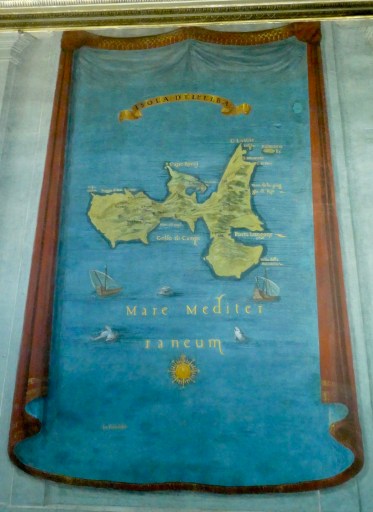
We always like to see maps, even when they’re high on a wall. Here’s Elba:
And there’s a lot going on in this depiction of Perseus rescuing Andromeda, including the musical accompaniment in the lower right.

And here’s more music, with Pan teaching Daphnis to play the pipes. I like the hooves.

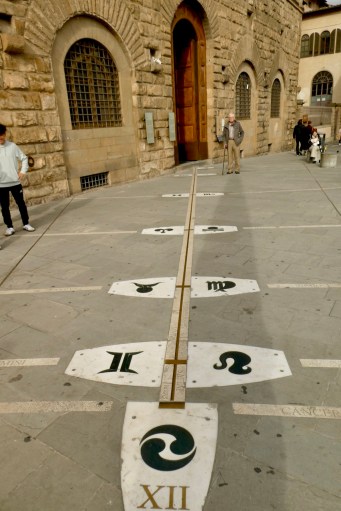
The Uffizi having overwhelmed us, we turned from art to science, and went around the corner to the Galileo Museum. Outside, there’s a sort of sundial, whose tall pillar casts a shadow on the pavement, though it’s hard to see on a cloudy day. The helpful person in this photo shows you the top of the shadow. It seemed correct for November.
This model by Copernicus shows a straightforward view of the solar system

and this much larger model is, uh, more elaborate.

Here’s an unusually colorful clock/calendar showing time reckoned even at the scale of the planets

and here’s a spiral thermometer, assuming that you can count the little dots to read the temperature:

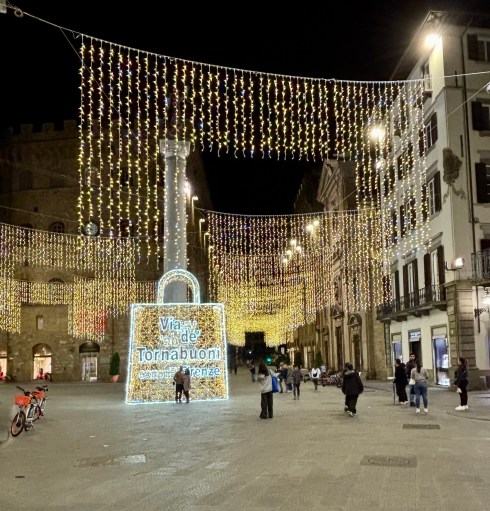
Finally, since it’s past Halloween, it must be time to devote ourselves to Christmas shopping. The streets are as flashy as the shop windows:
 The MHB Foghorn